Minnesota’s family law landscape has changed. On May 15, 2024, Governor Walz signed into law H.F. 3204, which went into effect on August 1, 2024. The new law updates statutes related to custody and parenting time, spousal maintenance, antenuptial and postnuptial agreements, and assisted reproduction. Here, Boulay’s Divorce Financial Services Team breaks down the key changes related to spousal maintenance and what you need to know.
Spousal Maintenance Statute Updates
Spousal maintenance (also known as alimony, spousal support, or simply maintenance) can be a contentious issue in divorce proceedings. To make matters worse, Minnesota’s prior statutes provided little guidance on potential spousal maintenance awards. While courts were required to consider various factors when assessing need, judicial officers had significant discretion in determining the amount and duration of the spousal maintenance award. This often led to unpredictable and inconsistent outcomes across Minnesota’s various counties, and even within each county.
However, new legislation effective August 1, 2024, modified the spousal maintenance statutes. Under the new legislation, there were no substantive changes to the threshold inquiry of whether spousal maintenance is appropriate, but judicial officers now have more specific guidelines on how the amount and duration is determined.
New Terms
Previously, Minnesota statutes used the terms “temporary” and “permanent” when referring to a spousal maintenance order. However, these terms were misleading, as “temporary maintenance” didn’t necessarily mean temporary and “permanent maintenance” didn’t necessarily mean permanent. For instance, individuals receiving temporary spousal maintenance for a specified period could motion the court to extend the original term; and permanent spousal maintenance was always going to end upon the death of either party, remarriage of the recipient (unless agreed to otherwise), or by future court order. Further conflating terms, temporary maintenance could refer to either spousal maintenance awarded during a temporary proceeding (before a final decree was issued) or an award of spousal maintenance for a specified amount of time (commonly referred to as rehabilitative maintenance).
The new legislation uses the following terms to describe the types of maintenance awards:
- Permanent spousal maintenance is now called indefinite maintenance
- Temporary spousal maintenance awarded for a specified period is now called transitional maintenance
- Spousal maintenance awarded in temporary proceedings is now called temporary maintenance
Duration of Maintenance
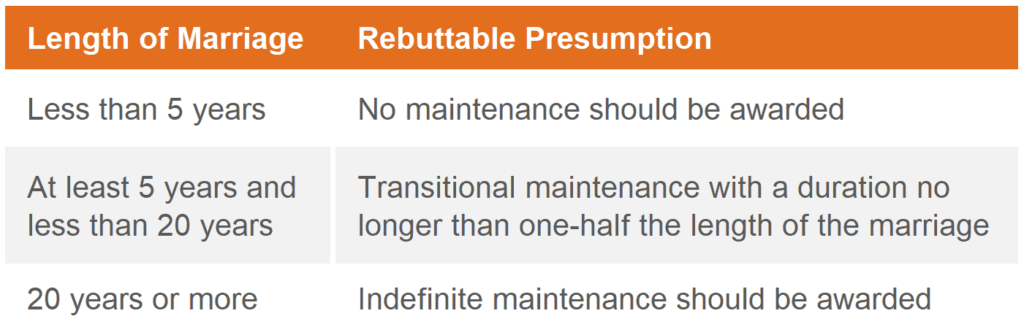
One of the most notable amendments to the spousal maintenance statute is the addition of specific language regarding the duration of a spousal maintenance award. According to the new legislation, duration of maintenance will now be rebuttably presumed (which just means it’s the default of the Court, absent unique circumstances) for a period based entirely on the length of the marriage—which is defined as “the period from the date of the marriage until the date of the commencement of the action.”
Amount of Spousal Maintenance Award
When determining the amount of spousal maintenance to be awarded, the new legislation modified several relevant factors the Court must consider. One of the critical changes in the legislation is the revised approach to assessing “the standard of living established during the marriage.” Previously, Courts aimed to maintain the standard of living post-divorce similar to that experienced during the marriage. However, the new legislation adjusts this factor to also consider, “and the extent to which the standard of living was funded by debt.” This new language is significant, as there are many marriages that have a high standard of living—brand-new cars, big houses, and exotic vacations—that were partially funded by leases, loans, and/or credit card debt. Obviously, this is not sustainable in the long-term for even one household, let alone when trying to support two households.
As may be expected, creating a “marital standard of living budget” can be one of the most challenging and tedious aspects of divorce. Yet, this step is crucial whether you are advocating for or contesting a maintenance award. Ensuring that budgets are accurate and reasonable from the start will make your case for/against spousal maintenance more credible and persuasive. Yet, if your marital financial situation is complex—with multiple checking and savings accounts, credit cards, brokerage accounts, lines of credit, etc.—or if you are not well-versed in your marital finances, hiring a divorce financial expert can be highly beneficial. A divorce financial expert can conduct a detailed analysis of spending—and the source of spending funds—that occurred during the marriage. This analysis helps ensure that the marital standard of living analysis is thorough, accurate, and well-documented, significantly aiding in achieving a fair outcome.
Helping You Get There…
Whether you’re seeking an award of spousal maintenance or defending against it, determining the marital standard of living and your monthly cash flow is essential. When you are ready, Boulay has a team of dedicated professionals with years of experience providing divorce financial services who are here to assist you. Contact us today, and a member of Boulay’s Divorce Financial Services Team will schedule a consultation to discuss your needs.