Among your duties as an ERISA fiduciary, minimizing the investment costs associated with your plan is a key objective. As you look for ways to reduce costs in your 401(k) plan, collective investment trusts (CITs) may be a worthwhile consideration.
CITs are tax-exempt, pooled investment vehicles maintained by banks or trust companies (trustees), which are available only to ERISA-qualified retirement plans. Though CITs are structured much like mutual funds, they are exempt from many of the regulatory requirements that drive mutual fund fees. This structural cost advantage has resulted in the rapid growth of CIT popularity and adoption among qualified retirement plans.
If you are considering offering CITs in your 401(k) plan, here is what you should know.
CITs vs. Mutual Funds
From your plan participants’ point of view, a CIT may appear very similar to a mutual fund. Both investment vehicles pool the funds of many investors and invest that money into securities such as stocks and bonds. Both are liquid daily, meaning participants can add or remove funds on a daily basis.
However, mutual funds and CITs differ in several important ways. One major difference between CITs and mutual funds is who can access each type of investment vehicle. Whereas mutual funds are widely available and the typical investor in a mutual fund is an individual, CITs are available exclusively to certain employer retirement plans. Hence, individual investors may only invest in a CIT through their employer’s qualified savings plan.
Perhaps the most key difference between the two investment vehicles is costs. Mutual funds are registered with the Securities and Exchange Commission (SEC), and thus must adhere to strict regulations that require more operational, disclosure and reporting work, resulting in higher costs. Additionally, to serve the needs of the numerous individual investors, mutual funds have higher administrative, distribution and marketing costs.
Meanwhile, CITs are not regulated by the SEC. Without these strict requirements, and because CITs only accept investments from certain qualified plans (instead of many individual investors), a CIT typically requires less work and has lower associated costs. Additionally, CIT fees can often be negotiated and are more flexible, with larger plans often qualifying for lower fees. Mutual fund fees, on the other hand, don’t differ from client to client, and because they are set by the investment firm, are non-negotiable.
Other key differences include:
-
-
- Regulations
Investors may assume that without SEC regulation, CITs have less regulatory oversight than mutual funds. However, CITs are subject to a variety of federal and state laws and regulatory bodies, including the Office of the Comptroller of the Currency (OCC) and the Department of Labor (DOL). Additionally, to the extent that ERISA plan assets are invested, CITs must abide by ERISA’s rules and regulations and meet minimum standards of conduct. The CIT trustee is held to ERISA fiduciary standards.
-
- Transparency
Mutual funds are thought to offer greater transparency to investors due to the public reporting and disclosures required. Information about mutual funds is publicly available on trading platforms and can be tracked using the ticker symbol.
While CITs are not publicly traded, most CIT managers provide fact sheets, standardized performance information, expense disclosures, and investment commentary. Therefore, CIT participants have access to the same information about CIT investments as they would a mutual fund. CIT trustees may also choose to offer a ticker symbol so the CIT can be publicly tracked by investors. Not all CITs have a ticker, however, so fiduciaries should check before investing.
Is a CIT right for your retirement plan?
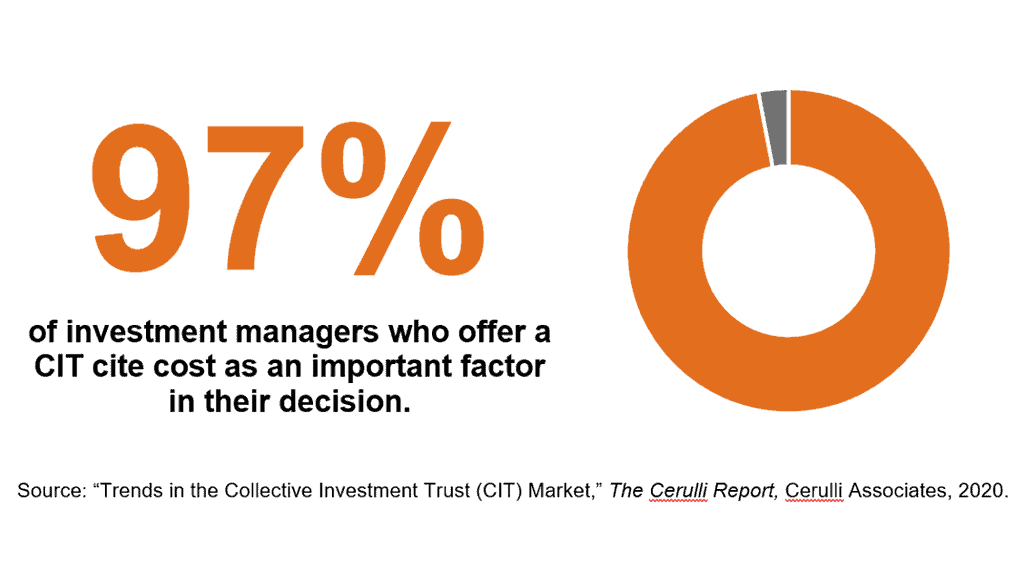
With all else held equal, CITs are typically cheaper than their mutual fund counterparts thanks to the cost advantages discussed above. This is what makes them so attractive to many plan fiduciaries—in fact, for the investment managers who opted to offer a CIT, 97% report that cost was an important consideration.
Boulay Can Help
If you are a retirement plan fiduciary looking to minimize your plan’s investment costs, CITs may be the right solution. However, it’s essential that fiduciaries carefully consider all options and the circumstances of their plan, to select the investments that are best for their participants. For those seeking more information on CITs and assistance with plan administration and investments, Boulay is here to help. Contact a Boulay advisor today at 952.893.9320 or learnmore@boulaygroup.com.
Investment Advisory Services offered through Boulay Financial Advisors, LLC a SEC Registered Investment Advisor. Certain Third Party Money Management offered through Valmark Advisers, Inc. a SEC Registered Investment Advisor. Securities offered through Valmark Securities, Inc. Member FINRA, SIPC
Boulay PLLP and Boulay Financial Advisors, LLC are separate entities from Valmark Securities, Inc. and Valmark Advisers, Inc. Prime Global is not affiliated with Valmark Securities, Inc. and Valmark Advisers, Inc.