The 2026 tax year is coming to a close, but businesses still have time to take steps that may reduce their federal income tax liability before year end. From maximizing depreciation deductions to evaluating qualified business income opportunities, proactive planning can help your business capture available tax benefits and avoid missed savings opportunities.
The following year-end tax planning strategies for businesses highlight several areas business owners should review before December 31, 2026.
Key Takeaways
- Businesses placing eligible assets in service during 2026 may qualify for 100% bonus depreciation.
- Section 179 expensing offers flexibility for deducting qualifying asset purchases.
- Manufacturers may benefit from the Qualified Production Property deduction.
- Research and experimental expenses may qualify for valuable deductions or tax credits.
- Business owners should evaluate qualified business income deduction opportunities and excess business loss limitations before year end.
1. Accelerate Tax Deductions with Bonus Depreciation and Section 179 Expensing
If you acquire and place eligible new or used assets in service during 2026, you may benefit from the 100% first-year bonus depreciation deduction.
Eligible assets may include:
- Machinery and equipment
- Certain business vehicles
- Off-the-shelf computer software
- Qualified improvement property (QIP)
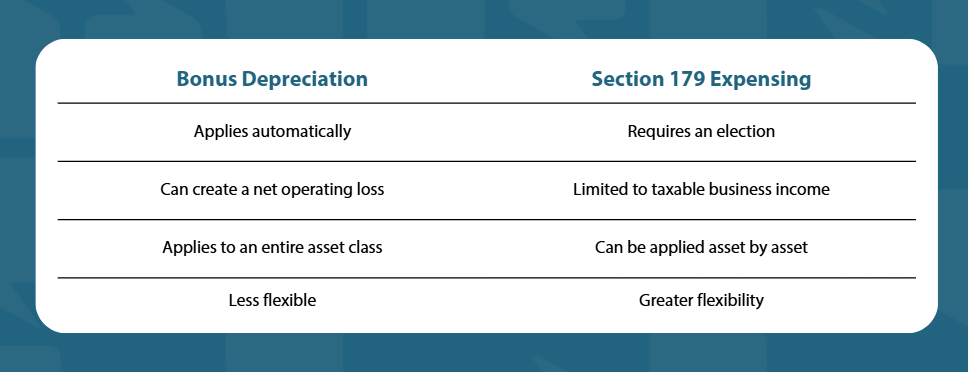
Bonus depreciation generally applies automatically to purchases of eligible assets placed in service during the tax year. Businesses can elect out if doing so better supports their overall tax strategy, although the election applies to an entire asset class.
Another valuable depreciation-related tax break is the Section 179 expensing election. For 2026, businesses can deduct up to $2.56 million of qualifying purchases. The deduction begins to phase out dollar-for-dollar when qualifying purchases exceed $4.09 million.
Bonus Depreciation vs. Section 179 Expensing
Before making significant purchases, evaluate:
- Cash flow needs
- Revenue projections
- Financing terms
- Other available tax incentives
- Future-tax-year planning opportunities
In some situations, delaying a deduction may provide greater long-term tax benefits.
2. Claim the Qualified Production Property Deduction
Manufacturers with new construction projects nearing completion may benefit from placing property in service before year end.
Businesses may qualify for a temporary depreciation deduction for qualified production property (QPP) placed in service after July 2, 2025, and before January 1, 2031. This provision allows eligible businesses to deduct 100% of a QPP’s adjusted basis in the year it is placed in service.
Unlike bonus depreciation, the QPP deduction requires an election.
To qualify, property generally must:
- Be nonresidential real property
- Be located in the United States
- Be used in a qualified production activity
- Be placed in service between July 4, 2025, and December 31, 2030
Manufacturing, production or refining activities must occur within the physical space of the property.
Property uses that generally do not qualify include:
- Office space
- Administrative functions
- Lodging facilities
- Parking areas
- Sales operations
- Research activities
- Software development
- Engineering operations
- Storage of finished goods
Additional eligibility rules apply, including restrictions on construction dates and property use.
3. Identify Research and Experimental Expenses and Tax Credits
Many businesses overlook valuable tax incentives because they assume research-related benefits apply only to technology or scientific companies.
However, the Section 174 deduction for research and experimental (R&E) expenses and the Section 41 research credit often apply much more broadly.
Activities that may generate qualified research expenses include:
- Developing new products
- Improving existing products
- Enhancing manufacturing processes
- Creating new production methods
- Testing prototypes
- Eliminating technical uncertainty
Under current rules, businesses may deduct eligible domestic R&E expenses in the year incurred or paid, regardless of whether a project is complete. Alternatively, they may amortize those costs over at least five years.
Foreign qualified expenses generally must be amortized over 15 years.
Businesses generally have two potential tax benefits:
- A Section 174 research and experimental expense deduction
- A Section 41 research credit
In many situations, businesses cannot claim both benefits on the same expense.
If a business claims the research credit, it generally must reduce the deduction by the credit amount. Alternatively, a Section 280C election may allow the business to reduce the credit while retaining the full deduction.
Because the optimal strategy varies, modeling different tax scenarios can help maximize savings.
4. Maximize Your Qualified Business Income Deduction
The Section 199A qualified business income (QBI) deduction allows owners of certain pass-through businesses to deduct up to 20% of qualified business income.
Businesses that may qualify include:
- Sole proprietorships
- Partnerships
- S corporations
- Many limited liability companies (LLCs)
QBI generally consists of the net amount of qualified income, gain, deduction and loss connected with a U.S. trade or business.
The One Big Beautiful Bill Act (OBBBA) expanded the deduction’s phase-in ranges beginning in 2026, allowing some taxpayers to claim larger deductions.
For 2026, the wage and investment limitations generally phase in when taxable income falls between:
- $201,750 and $276,750 for individual filers
- $403,500 and $553,500 for married couples filing jointly
The deduction may be limited to the greater of:
- 50% of W-2 wages paid to employees, or
- 25% of W-2 wages plus 2.5% of the unadjusted basis of qualified business property
Another limitation applies to specified service trades or businesses, including many professional services firms and investment-related businesses. Engineering and architecture firms generally remain eligible.
Year-end planning strategies may include:
- Maximizing retirement plan contributions
- Deferring income into 2027
- Accelerating deductible expenses into 2026
- Increasing wages where appropriate
- Purchasing qualified business property before year end
Before implementing these strategies, evaluate any additional tax and cash-flow implications.
5. Plan for the Excess Business Loss Limitations
Noncorporate taxpayers generally can use business losses to offset income from other sources. However, federal tax law limits the amount that can be used in the current year.
Business losses may offset:
- Salary and wages
- Self-employment income
- Interest income
- Dividend income
- Capital gains
Losses exceeding the annual limit generally become net operating loss (NOL) carryforwards, which remain subject to certain limitations in future years.
The OBBBA made the excess business loss limitation permanent.
For 2026, the limitation decreases to:
- $256,000 for individual taxpayers
- $512,000 for married couples filing jointly
Businesses generating substantial losses through bonus depreciation, currently deductible research expenses or other tax benefits may not receive the full value of those deductions immediately.
If projected losses approach the limitation, consider:
- Accelerating taxable income
- Deferring certain deductions
- Evaluating future NOL utilization
- Modeling the impact across multiple tax years
Because these decisions can affect future tax liability, businesses should review them carefully before year end.
Common Year-End Tax Planning Opportunities for Businesses
Before year end, business owners should evaluate:
- Capital equipment purchases
- Manufacturing facility investments
- Research and development activities
- Pass-through entity income levels
- Retirement plan contributions
- Net operating loss positions
- Revenue timing opportunities
- Expense acceleration strategies
Reviewing these areas before December 31 can help identify opportunities that may no longer be available after the tax year closes.
Take a Proactive Approach to Year-End Tax Planning
The months leading up to year end can present valuable opportunities to reduce tax liability, improve cash flow and strengthen your business’s financial position. The right strategy depends on your industry, entity structure and long-term goals.
Contact Boulay today to discuss your year-end tax planning opportunities and build a tax strategy designed for your business.
Frequently Asked Questions About Year-End Tax Planning
What are the most common year-end tax strategies for businesses?
Some of the most common strategies include:
- Bonus depreciation
- Section 179 expensing
- Research tax incentives
- QBI deduction planning
- Managing excess business losses
- Retirement plan contribution planning
What is the difference between bonus depreciation and Section 179 expensing?
Bonus depreciation generally applies automatically and can create a tax loss. Section 179 requires an election and provides greater flexibility by allowing businesses to select specific assets and deduction amounts.
Who qualifies for the QBI deduction?
Owners of sole proprietorships and many pass-through entities, including partnerships, S corporations and certain LLCs, may qualify, subject to income and other limitations.
When should businesses start year-end tax planning?
Businesses should begin reviewing tax-saving opportunities well before Dec. 31 to allow time to implement strategies that affect their current-year tax position.